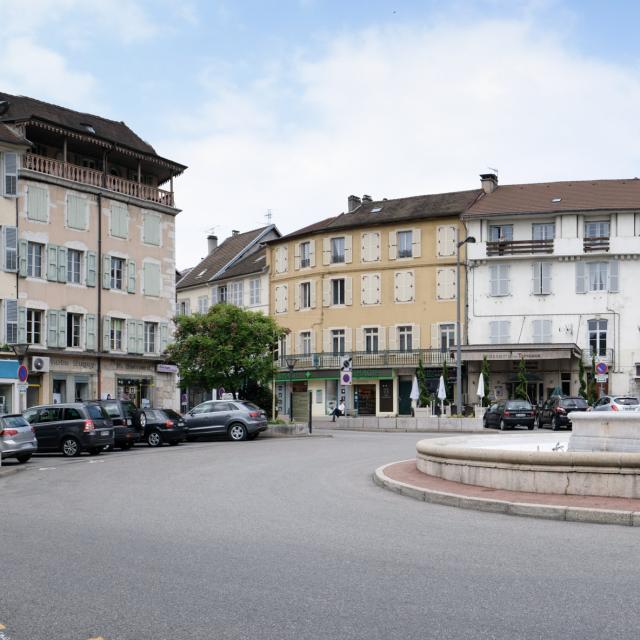
There are four parking zones managed by the City of Belley:
– Paid parking:
Short-term parking (maximum 1 hour 30 minutes per half-day)
+ 30 minutes free per vehicle, once per day (To benefit from the free time, you must enter your license plate number and take a ticket from the parking meter).
Monday to Friday 9:00 a.m. – 12:00 p.m. // 2:00 p.m. – 7:00 p.m. and Saturday 9:00 a.m. – 12:00 p.m., excluding public holidays.
These spaces are located on: Rue de la République / Rue des Cordeliers / Rue Saint-Martin / Rue Georges-Girerd / Grande Rue.
Long-term parking (maximum 3 hours 30 minutes per half-day)
+ 30 minutes free per vehicle, once per day. (To benefit from the free parking time, you must provide your license plate number and take a ticket from the parking meter.)
Monday to Friday 9:00 AM – 12:00 PM // 2:00 PM – 7:00 PM and Saturday 9:00 AM – 12:00 PM, excluding public holidays.
These parking spaces are located at: Place de la Victoire / Boulevard du Mail (odd-numbered side) / Lower end of Grande Rue (from the stop sign to Rue Sainte Marie) / Place Baudin.
Monthly or annual parking permits can be purchased from the Municipal Police by appointment at 04 79 42 31 71.
Parking can be paid for via:
Parking meters (payment by coins and credit card)
The EasyPark smartphone app
– Blue Zone: Boulevard de Verdun / Place des Terreaux / Rue de la Résistance
Free for 1 hour, Monday to Friday, 9:00 AM – 12:00 PM // 2:00 PM – 7:00 PM and Saturday, 9:00 AM – 12:00 PM, excluding public holidays. These spaces accept the European parking disc.
– Short-Term Parking
3 free short-term parking spaces (10 minutes) on Rue Saint-Martin
– Free Zone: throughout the rest of the town.
Some examples of recommended free parking near the town center and the Tourist Office:
– Parking on Rue du Promenoir.
– Parking des Charmilles (Rue Pablo Picasso).
– Parking on Rue Pierre Marcel Wiltzer.
– Parking at Place de la Cathédrale.
– Parking Rue Récamier.
– Parking on Avenue Paul Chastel.